
Is a Long-Range EV Battery Worth the Extra Cost?
A bigger EV battery isn’t always better. Analyzing a University fleet shows that bigger batteries aren’t always needed and add expense.
New drivers have historically expressed range anxiety when first driving electric vehicles (EVs). This was especially true with first-generation EVs that operated with limited range in a landscape of minimal public charging infrastructure. However, that operational reality has changed substantially.
Major breakthroughs in battery energy density, paired with more efficient electric powertrains and highly optimized vehicle aerodynamics, mean that new EVs offering 300+ miles of range are the new normal. At the same time, there are now about 250,000 public charging ports in the U.S., a 700% growth rate over the last 10 years, and an almost 2,000% growth rate when looking strictly at public fast-chargers. When you take both of those advancements into consideration, the traditional case for range anxiety is less relevant than ever.
Still, range anxiety is far from gone from fleet managers' minds, especially if they don’t have much experience operating EVs. One common way they try to mitigate this concern is by purchasing EVs with the biggest batteries available to provide the maximum possible range. However, this strategy raises a critical question for procurement departments: Is a long-range EV battery worth the extra cost? This strategy comes at a cost because high-voltage batteries are the most expensive component of an EV.
The best way to mitigate range anxiety is by leveraging energy data and establishing the battery size needed for each application based on a predictive daily energy usage analysis. Following this approach, Sawatch Labs recently used advanced EV battery analytics to work with a top California university to analyze almost 900 of their vehicles using their real-world telematics data.
A special focus of this project was their electric low-speed vehicle (e-LSV) fleet of 250 assets. The university was looking to replace its existing e-LSVs, which rely on previous-generation lead-acid battery technology, with new-generation lithium-ion batteries. But the main question remained: How big of a battery does each vehicle actually need?
What 250 LSVs Reveal About Battery Size
The fleet was considering two GEM e-LSVs as replacements: one with a 16 kWh battery (15 kWh usable), and the other with an 8 kWh battery (7.5 kWh usable). They were initially planning on replacing all e-LSVs with the larger battery option. However, Sawatch Labs analyzed 12 months of telematics data for these vehicles and discovered that, for every single one of them, getting the smaller battery option made the most operational and financial sense.
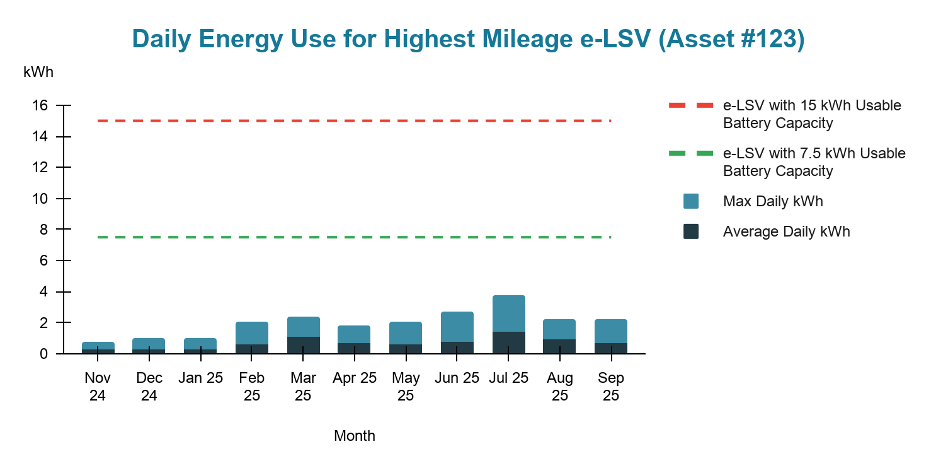
Consider the highest-mileage e-LSV in the fleet, Asset #123, shown in the graph below. It tracked 4,230 miles in a year. Despite its high mileage for an LSV, the maximum daily energy use it incurred all year was 3.8 kWh, while its daily average sat at a mere 1 kWh.
Our analysis proved that the smaller 8 kWh e-LSV would safely and consistently meet these daily energy requirements, as shown below, provided the vehicle is regularly charged.
The Cost of Bigger Batteries
The massive area below the red dotted line in the graph above might completely eradicate range anxiety or allow drivers to go several days in a row without plugging in, but it comes at a major financial cost.
The 16 kWh e-LSV costs an additional $4,000 per unit compared to the 8 kWh model. If the university were to procure these larger batteries for its entire fleet of 250 LSVs, it would result in a $1,000,000 cost increase, making it vital to analyze whether a long-range EV battery is worth the extra cost.
Is that seven-figure price differential worth it? Not if the e-LSVs are regularly charged. Yet, the fleet was planning on purchasing the bigger battery option “just in case”. These custom EV analytics are now revealing a substantial source of savings for the fleet.
But battery savings are only one part of this story. The newer e-LSVs come standard with a 1.2 kW on-board charger, but an optional 2.2 kW or 4.4 kW on-board fast-charger upgrade is offered and was enticing to the fleet to reduce overall charging times. Opting for the faster on-board charger costs $1,200 more per vehicle, which translates to an additional $300,000 in procurement costs if adopted across the entire 250-LSV fleet, as seen in the graph below.
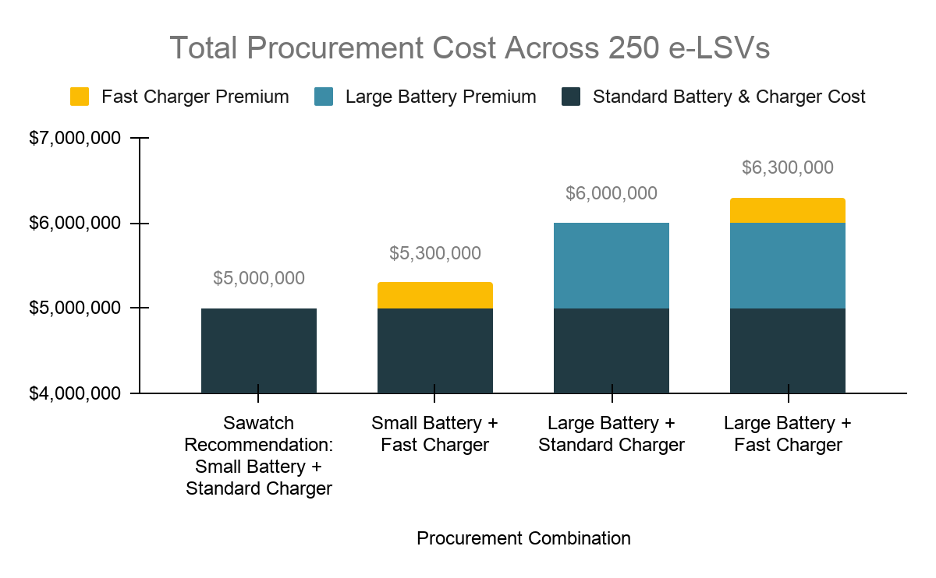
Our analysis showed that the standard on-board charger provided similar daily charging times compared to the faster alternatives, given their low daily energy draws. Furthermore, avoiding these add-ons eliminates the substantial electrical infrastructure and labor costs required to upgrade the university's existing Level 1 infrastructure (not included in the graph above).
Battery Usage, Operational Maturity, and Financial Savings
In their 2026 State of Commercial Transportation report, telematics firm Geotab analyzed the depth of discharge (DoD - the amount of battery capacity used between charges) among commercial vehicles in the United States and Europe. The results show a stark geographic contrast.
American fleets use 36% of their battery on average, while European fleets use 48%.
This insight reveals that fleets operating in the U.S. are still heavily conditioned by historical range anxiety, leading them to utilize their assets in a highly conservative way. On the other hand, European fleets, which generally possess more experience operating EVs and navigating a more robust public charging network, push battery utilization harder and even utilize mid-shift charging to exceed the daily range capacity.
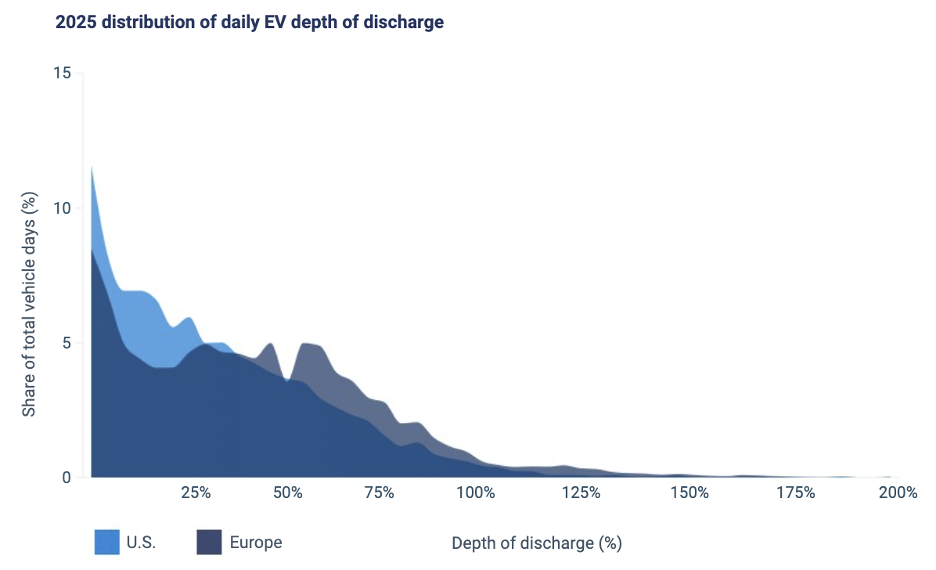
The takeaway from this macro data is clear: range-anxious American fleets are leaving significant financial savings on the table because they often assume that a long-range EV battery is worth the extra cost. By buying vehicles with smaller batteries, increasing their discharged depths, and charging more frequently, they can substantially increase their savings.
Overcoming the Friction in EV Charging Logistics
To successfully deploy smaller, more cost-effective batteries, a fleet requires a supportive operational charging strategy. This applies both to off-shift charging as well as on-shift opportunity charging, which can unlock additional value.
However, American fleets are frequently discouraged from plugging in opportunistically if the charging process isn’t simple and seamless. Drivers will not plug in mid-shift if finding a charger or paying for it is complicated, nor will they take EVs home and charge them if getting reimbursed becomes a burden.
While Sawatch Labs provides fleets with the custom EV analytics needed to make these rightsizing decisions, our parent company, WEX, simplifies the payment experience for them with two key offerings:
En-Route EV Payments: Accessing 175,000+ public chargers across almost 20 different networks in one physical card (which can be combined with a regular fuel card with acceptance at 95% of gas stations), along with an app for finding and activating chargers.
Streamlined Take-Home Charging Reimbursements: Automating At-Home EV charging reimbursements that get issued within days, simplifying the driver experience while allowing fleets to tap into low residential charging rates.
When data-driven battery sizing is paired with a seamless charging and payment ecosystem, the risk of downsizing batteries is drastically reduced.
Why Extra Battery Range is Rarely Worth the Premium
As fleets adopt more EVs and seek to maximize their return on investment, choosing the optimal battery size for each application is key. Bigger batteries come at a substantial cost, so underutilizing them inevitably inflates the total cost of ownership (TCO) compared to rightsized ones that are optimally utilized.
In the end, partnering with a data-driven EV analytics expert ensures you can unlock savings from the beginning by rightsizing your EV batteries (and your EV charging infrastructure, too).
Get in touch with Sawatch Labs for a free consultation and demo of our EV analytics suite of products!