
How EV Fleet Cost Savings Scale with Fuel Price Volatility
A Case Study from a California Fleet
Recent geopolitical volatility has sent shockwaves through global energy markets in large part due to the war in Iran and related closing of the Strait of Hormuz. With nearly 20% of global crude oil passing through the Strait, even minor disruptions create major price spikes at the gas pump. For fleet managers, this instability directly impacts operating cost calculations and long-term capital investments.
While most fleets recognize that gasoline prices are unpredictable no matter the political climate, many underestimate how much that volatility increases the financial value of electrifying their vehicles. Even though electrification planning requires complex data analysis, leveraging fleet telematics data can provide a clear, customized roadmap to EV fleet cost savings. By applying a data-driven strategy, you can build a resilient fleet that meets both financial and operational goals.
One way this impacts a fleet is through total cost of ownership (TCO). TCO can be lowered when you replace gasoline vehicles with electric vehicles. These savings come from lower fuel costs, reduced maintenance, and improved energy efficiency—and can increase significantly as fuel prices rise.
A Data-Driven Approach to Assess Electrification Benefits
Since 2022, Sawatch Labs, a WEX Company, has been helping a Fortune 500 company in California convert to a mixed-energy fleet. Part of this work involved analyzing their 388 gasoline-powered vehicles. Using telematics data, this detailed analysis scored each vehicle to determine if it was a strong operational and economic fit for electrification. The gasoline fuel cost baseline used for this analysis was $5.11/gallon.
Sawatch’s analysis identified that 309 of those vehicles could be replaced with electric vehicles (EVs), which would save $9.97+ million in Total Cost of Ownership (TCO) over the vehicles’ lifetime.
+$9.97M USD
Cost of Inaction
TCO Savings Missed by Not Electrifying
Taking the Analysis One Step Further: Fuel Sensitivity Analysis
Sawatch Labs performed a fuel price sensitivity analysis for this fleet using the following scenarios:
+10% ($5.62/gal) - “Conservative Recovery”: Models a scenario where gas prices stabilize midway between previous and current prices.
+20% ($6.13/gal) - “Current Reality”: Reflects the average regular gasoline price increase that their county has seen since February 28, 2026.
+35% ($6.90/gal) - “Sustained Escalation”: Models the impact of persistent supply chain disruptions and continued geopolitical volatility in the short-to-mid term.
+50% ($7.67/gal) - “Severe Shock”: A high-impact stress test showing the fleet's risk exposure if the conflict escalates further or compounding global events occur in the mid-term.
While this analysis was conducted in late March 2026, gas prices have risen by 50% as of May 2026, making the Severe Shock scenario a reality.
For many fleets, this translates into a strong return on investment, with electrification delivering increasing financial benefits over the vehicle lifecycle.
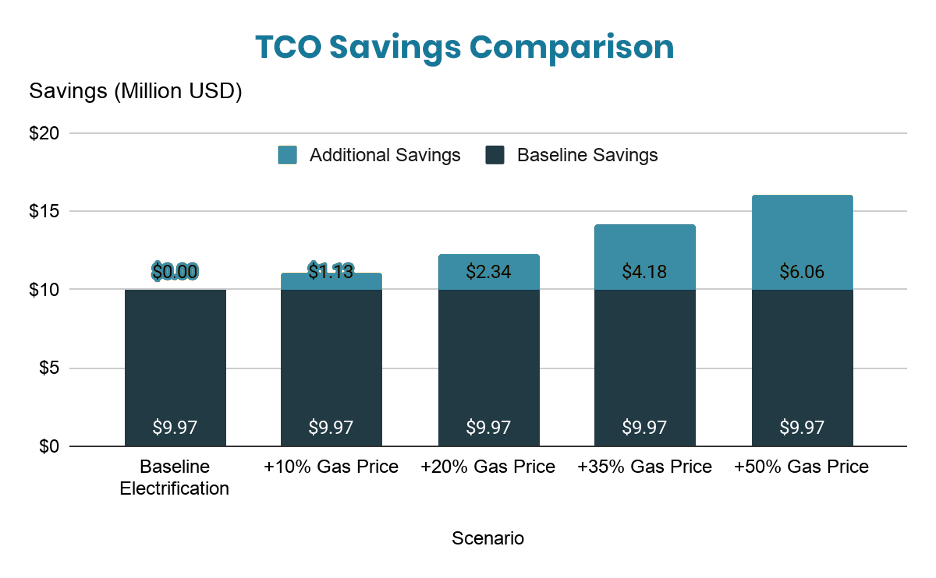
The following graph stacks the baseline EV fleet cost savings with the additional savings generated under each fuel price scenario.
Magnified Returns from Fleet Electrification
The data reveal a powerful multiplier effect: The rate of TCO savings increases faster than the rate of fuel price increases. As gasoline prices rise, the margin of EV fleet cost savings expands disproportionately. For example, a +10% fuel spike results in an 11.3% increase in TCO savings (totaling $11.1M in savings), while a +35% spike yields a 42% increase (totaling $14.15M).
Why don’t the savings increase in a linear fashion?
To isolate the exact impact of fuel volatility, the analysis holds all other variables constant, including electricity rates. Because the electric baseline remains stable, the total percentage of savings accelerates faster than the price of fuel itself. This shows that fleets can not only accrue substantial savings by adding EVs into the mix, they can also protect themselves from fuel price inflation. This demonstrates that electric vehicles in a fleet can function as a financial hedge, performing better as the fuel market worsens. In a severe shock scenario (+50% fuel increase), this savings multiplier transforms the $9.97M baseline into a staggering $16.03M in TCO savings—a 60% jump.
Even as electricity prices rise, the benefits to EV remain
Accounting for projected electricity price increases moderates these findings slightly, but the core advantage remains. The U.S. Energy Information Administration shows a 5.3% CAGR (Compound Annual Growth Rate) for California’s commercial electricity prices over the last decade. However, according to the U.S. Department of Energy, internal combustion engine vehicles waste 3 to 4 times more energy than EVs. Once that massive efficiency gap is accounted for, the impact of electricity inflation on TCO is greatly reduced because EVs simply require far less energy to do the same amount of work.
This divergence is best illustrated by comparing 30 years of price data. While electricity prices follow a predictable "staircase" growth pattern, gasoline prices function as a "heartbeat" of volatility. This is a structural market reality: unlike gasoline, utility rates are typically overseen by public regulatory bodies or ratepayers. This oversight ensures that price changes are transparent and approved well in advance, providing fleets with a level of budget certainty that the volatile oil market cannot match. As shown in the graph below, which tracks U.S. national averages since 1996, gasoline prices surged to nearly 5x of their 1996 baseline at their peak, while electricity prices remained below a 2x increase over the same 30-year period.
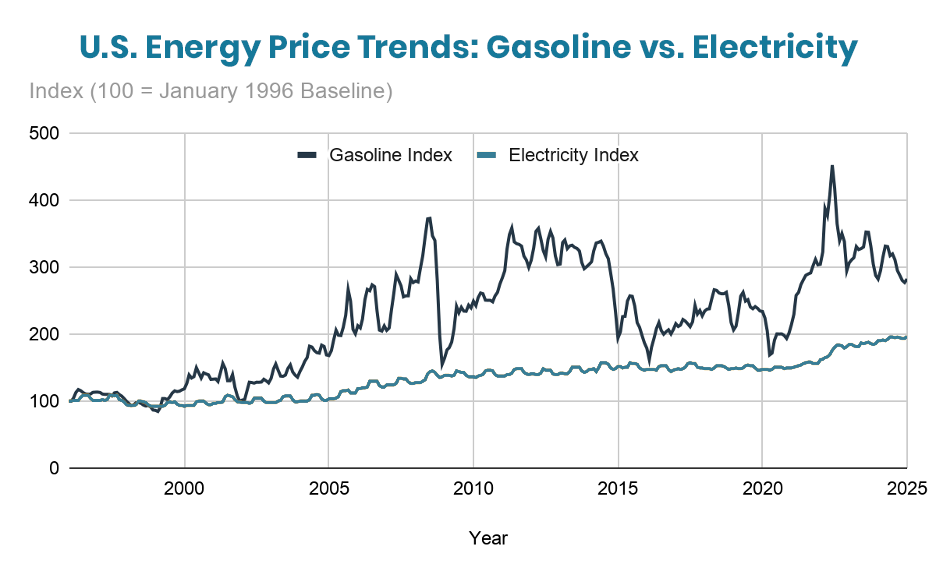
Sources: U.S. Energy Information Administration (EIA), Retail Gasoline Prices (Series: GASREGW); U.S. Bureau of Labor Statistics (BLS), Average Retail Electricity Prices (Series: APU000072610).
Final Thoughts on EV Fleet Cost Savings and Data-Driven Fleet Electrification
The key takeaway from this case study is that fleets should be proactive in assessing the suitability of electrifying a portion of their vehicles. Significant EV fleet cost savings can be realized, and these savings grow disproportionately as fuel prices rise. This is a critical financial hedge given how quickly global events can trigger market spikes.
A data-driven fleet electrification strategy ensures that fleets can identify the right vehicles for conversion and maximize total cost of ownership benefits.
Empower your fleet by starting to capture the financial savings of electrification. Get in touch with Sawatch Labs to learn more about our scientific approach to assessing EV suitability and optimizing charging infrastructure!